Portal medians are honest numbers attached to a dishonest story. The city-wide Camarillo median sold price sat at $870,000 in May 2026, up 2.4% from April and moving in about 65 days on market, with 80 homes trading and days on market falling from 73 to 65. Read as a shopping receipt for a house, the number is misleading. Read as a receipt for a block, it starts to make sense.
Central Camarillo is where this gap between the number and the asset gets widest. The core of the submarket sits inside a fifteen-minute walk of an Old Town commercial strip that is being reprogrammed by independent operators, a food hall, a mixed-use rebuild, and a warehouse anchor still under construction. The stock inside that walking radius is largely from the 1950s and 1960s. Most of the median is priced into the sidewalk, not the studs.
The Thesis, In One Sentence
If you offer $870,000 in Central Camarillo you are paying for the reprogramming radius of Old Town at today's cap. The house is a second-order asset, and unless you underwrite a renovation reserve alongside the offer, you will discover the same thing every buyer here eventually does — that the block was the purchase.
What The May 2026 Number Actually Measures
The Camarillo city-wide sold data has been remarkably steady this spring. April 2026 closed at a $870,000 median with 60 sales and homes averaging 75 days on market, selling at 99.6% of asking price. May tightened marginally, with 80 sales, prices up 1.9% year-over-year, and volume up 25% year-over-year. Across a broader early-2026 window, sale-to-list has hovered near 99.18% on roughly a 1.85-month supply.
Two takeaways matter for Central Camarillo buyers. First, this is not a market that punishes patient offers, because sellers are not clearing at premiums to list. Second, it is also not a market where fresh inventory sits, because supply is thin. The friction is not price war. The friction is that the assets themselves are uneven, and the median flattens that unevenness into a single misleading number.
The Coffee Cluster Test
Old Town's block-by-block value is not academic. You can walk it. Between Lewis Road and Carmen Drive, the district runs along Ventura Boulevard just south of the 101 in what the City describes as a small-lot area with mostly single-story commercial development, and the last eighteen months have brought a wave of independent operators who read the district as a going concern rather than a rescue project.
The clearest signal is the coffee cluster. Each of these names is a real business with a named operator committing to Old Town at 2025–2026 rents:
- Cafe Ficelle, run by Bryan Scofield, a classically trained baker from Lyon, France
- Carrara's, an Italian coffee-and-pastry concept already established in Moorpark and Agoura Hills, whose owner Mel Jones told the City's economic development team that Old Town was "the closest thing we can get to Italy in terms of shops, walkability, and a sense of community"
- American Pie Records & Coffee House, opened by Mike Curtis after a Los Angeles career, pairing a curated record collection with live music to extend visit time downtown
- Tree Lounge Coffee, the father-and-son project from Ricky and Matt Hernandez, sourcing beans roasted in Ventura, partnering with local bakeries, and rotating a gallery wall for local artists
- Kraft Vermicelli, founder Amy Truong, built specifically to fill an afternoon coffee-and-tea gap she identified on the strip
These are not tenants filling vacancy at concessions. They are operators betting a five-year lease on the district. That is what a walk-to-coffee premium looks like before it shows up in a comp set.
The Pipeline Behind The Block
Independent operators are a leading indicator. The lagging indicators are the capital projects, and there are four in motion inside or immediately adjacent to Central Camarillo that will finish reshaping the walking radius over the next eighteen to twenty-four months.
The Mark, a food-hall-format redevelopment, has already pulled in Café Ficelle, Rori's Creamery, and Topa Topa Brewing Co. among its tenants. Cedar-Oak, the mixed-use rebuild on Ventura Boulevard between Cedar Drive and Oak Street, added 23 apartments above roughly 6,000 square feet of commercial space, adding daytime and evening foot traffic to the same corridor. Central Plaza, at Arneill Road and East Ponderosa Drive, is under an Investec-led modernization that replaces the former Kmart with a 60,000-square-foot Vons Market as the center's new anchor. And on the west end of Camarillo Town Center, the long-contested Costco is now approved, a 160,000-square-foot warehouse with a 32-pump gas station targeting a late-2026 opening.
Behind all of that, the City is running a formal five-year planning process. The Camarillo Old Town Strategic Plan is meant to produce a clear path for the district, and Economic Development Manager Georg Winkler has framed it as a community-engagement effort meant to reveal the full potential of Old Town. Buyers reading Central Camarillo comps in July 2026 are pricing the pre-plan district. Sellers listing in early 2027 will be pricing something else.
The Renovation Reserve The Portal Doesn't Show
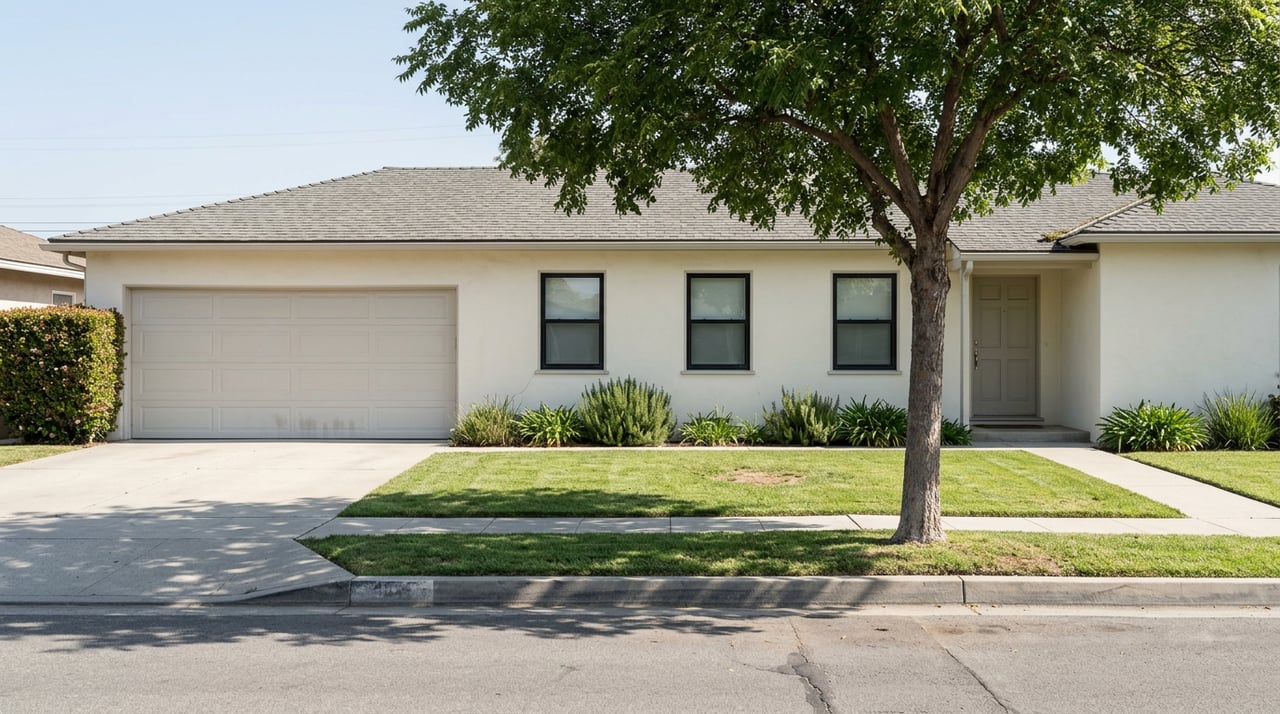
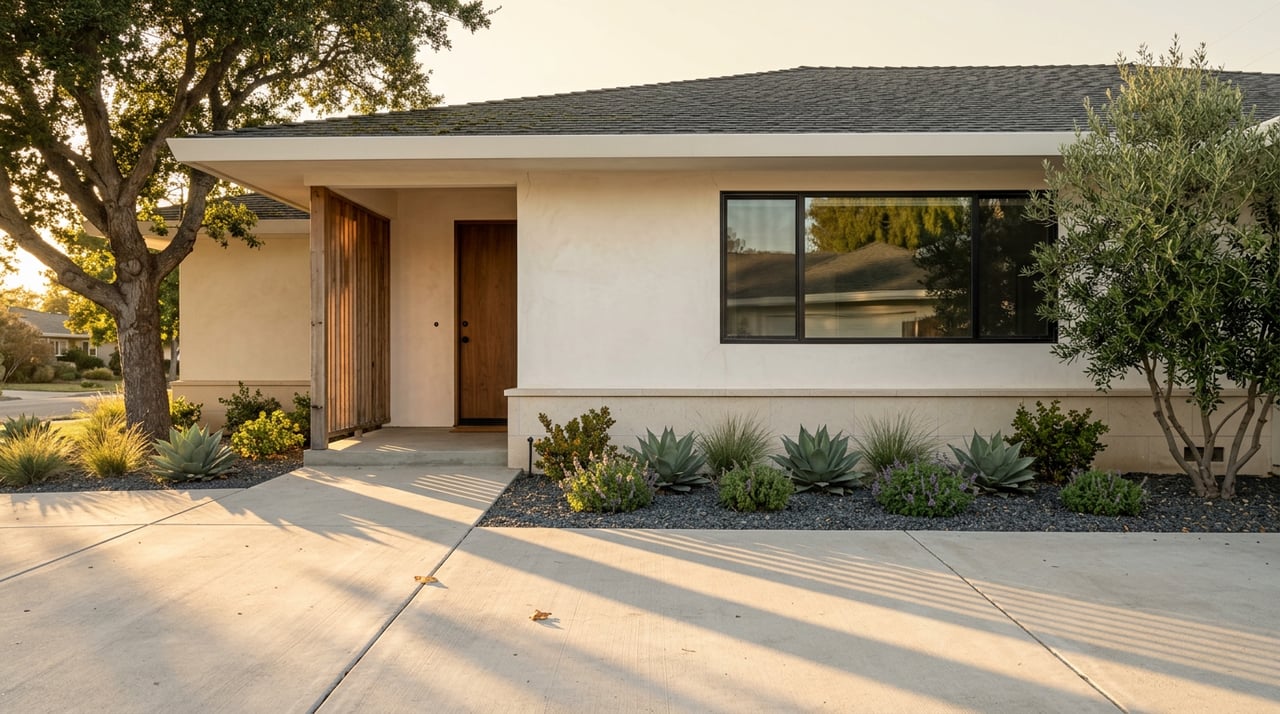
Now the honest part. The housing stock inside that walking radius is old. Central Camarillo's original core is characterized by ranch-style homes from the 1950s and 1960s, with layers of 1970s–2000s tract product filling in the outer streets. Median finishes across that stock are exactly what you would expect from a family-owned single-story that last saw a serious update in 2007.
The city-wide $870,000 median flattens two very different houses into one number. Consider what the same money buys inside the walking radius versus outside it:
| Feature | Old Town-Adjacent Ranch, 1962 build | Outer-Ring Tract, 1994 build |
|---|---|---|
| Typical footprint | ~1,400 sq ft, single-story, three-bedroom | ~1,800 sq ft, two-story, four-bedroom |
| Lot character | Rectangular, mature landscaping, alley in some pockets | Cul-de-sac, smaller yard, HOA in some tracts |
| Kitchens / baths | Frequently original or lightly updated | Typically one refresh cycle behind current spec |
| Systems | Original panel, galvanized sections not uncommon | Modern panel, copper throughout |
| Walk to Old Town coffee | 5–15 minutes | Drive |
| Renovation reserve to bring to 2026 spec | $120K–$225K, depending on kitchen/systems/roof | $40K–$90K, cosmetic |
| Underwriting story | You are buying the block | You are buying the house |
Neither is the "right" purchase. They are different products at the same headline price, and the offer strategy is not the same for both.
How This Changes Your Offer
If you are targeting the Old Town-adjacent ranch, run your numbers this way:
- Underwrite the block, not the finishes. The premium you are paying over comparable Camarillo tract stock is the reprogramming radius. That premium is real, and given the pipeline described above, it is more likely to expand than contract over the next twenty-four months.
- Set a renovation reserve alongside the offer, not after it. For a 1960s ranch inside the walking radius, budget six figures. Get a general contractor walkthrough before you remove the contingency, not after close.
- Read comps by vintage and block, not by ZIP. A 1994 tract sale six blocks from Old Town is not a comp for a 1962 ranch three blocks from The Mark. The portals will show them side by side. Treat them as different assets.
- Do not chase list price on speed. Homes cleared at 99.6% of asking in April 2026. There is room to negotiate on condition-adjusted value when a house needs work, and sellers of aging stock know it.
- Ask what closes before you close. Costco's opening, the Vons anchor at Central Plaza, and the next round of Old Town Strategic Plan actions will each move foot traffic patterns. Any of them landing between offer and close is an appraisal tailwind you can price into your terms.
FAQ
Is Central Camarillo faster or slower than the city as a whole? The city-wide market is running at roughly 65 days on market as of May 2026, down from 73 the prior month. Central Camarillo's walkable core tends to clear faster than the outer tract rings inside the same ZIP, because the block premium is doing more of the work than the finishes are. Ask for the days-on-market number for the specific block, not the ZIP.
Are the new Old Town openings priced into comps yet? Partially. The independent-operator cluster is already showing up in the qualitative descriptions of Old Town-adjacent listings. The capital projects — Central Plaza's new Vons, the Costco warehouse, and any actions coming out of the five-year Strategic Plan — are not fully priced in yet.
Where does the free trolley matter for value? Old Town is on the Free Trolley route, which quietly extends the effective walking radius. Blocks that look "just outside" Old Town on a map may still function as inside-the-radius stock because of the trolley loop. Confirm the stop before you assume a block is edge inventory.
Central Camarillo rewards buyers who separate the block from the house. If you would like the specific comp read for a street you are watching, or a candid walk-through of what a 1960s ranch actually needs before it appraises at 2026 spec, Puckett Team Real Estate has been pricing this submarket across two generations. Get your free home valuation, or ask us to sit with your buyer underwriting before you write the offer.